

In today’s volatile business environment, the greatest risk isn’t making the wrong choice—it’s settling for merely good enough. Organizations (and individuals) often mistake incremental success for optimal performance, locking onto strategies that deliver steady results but miss transformational opportunities.
This is the local optimum trap: reaching a performance peak that blinds us to much higher potential beyond. Our current position feels successful, alternatives seem risky or inferior, so we stop seeking breakthroughs.
Sometimes comfort masquerades as success. Adam Grant calls this “climbing Mount Stupid”—where our confidence peaks before we realize how much we don’t know. After our initial ascent, we may set up camp on our local performance peak. What was meant as a brief stopover becomes a permanent home.
Why Successful Companies Get Stuck
The Sunk Cost Fallacy
The most important thing to do if you find yourself in a hole is to stop digging.
—Warren Buffett
Leaders often cling to their chosen strategies and decisions. Having invested capital, brainpower, and organizational credibility, pivots may feel like failures—even when market signals demand change. This escalation of commitment undermines innovation and erodes competitive advantage.
The Dunning-Kruger Effect in the C-Suite
The fool doth think he is wise, but the wise man knows himself to be a fool.
—William Shakespeare
Research by psychologists David Dunning and Justin Kruger reveals a leadership blind spot: early success breeds overconfidence. Leaders who achieve initial wins may dismiss warning signs while they enjoy the view from the top of Mount Stupid. As complexity reveals itself, our confidence plummets. Unsure of our next steps, we may feel trapped in our current position. Only continuous learning and effort enable realistic assessment of capabilities, risks, and opportunities to improve decision-making.
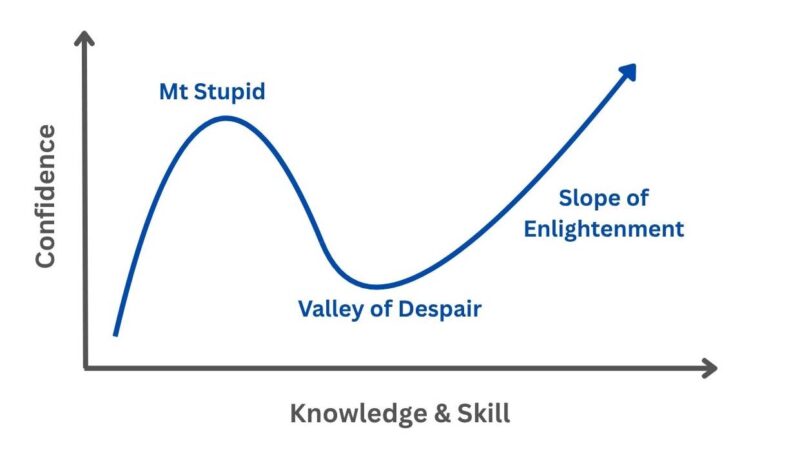
Adapted from Grant (2023b).
Descending Mount Stupid
Here’s an inconvenient truth: progress often begins with letting go. Leadership isn’t about defending foothills but creating safety to explore and aim higher. Great leaders recognize when they’re stuck and have the courage to start anew.
Avoid getting stuck on Mount Stupid by:
- Questioning settled routines and successes
- Encouraging healthy dissent, even if disruptive
- Dropping unproductive habits and assumptions (See: Dropping Your Tools)
Leadership Action Plan
Immediate (This Quarter)
- Identify your three longest-standing strategic assumptions. What evidence do you have they are still valid?
- Conduct a “pre-mortem” assuming strategic failure. What caused it? What were the warning signs?
- Inventory resource-draining strategies, products, or processes that do not deliver proportional returns
Near-Term (Next Six Months)
- Create formal mechanisms like “sunset committees” empowered to end legacy initiatives
- Develop metrics rewarding strategic pivots, not just consistent execution
Medium-Term (This Year)
- Build leadership pipelines favoring adaptive, enterprise thinking
- Redesign incentives to prize breakthrough over incremental gains
The Bottom Line: Embrace an Abundance Mindset
Abundance stems from refusing to settle. Markets consistently create new value, and the highest returns come from seeking unexplored opportunities rather than protecting existing ones. Recognizing and escaping local optima is a critical strategic leadership skill.
The question isn’t whether to climb down from your current peak—it’s whether you’ll do so proactively or wait for competitors to force your descent.
Reflection Questions
What consistent results are masking suboptimal performance?
Which long-held beliefs no longer serve me—and how might I let them go?
How much time do I spend defending existing approaches versus exploring alternatives?
How do I reward or inadvertently punish strategic flexibility?
How am I creating space for doubt and curiosity for myself and my team?
What would a competitor with no legacy constraints do in our market?
What “mountains” are calling to me beyond current foothills?
References
Dunning, D., & Kruger, J. (1999). “Unskilled and unaware of it: how difficulties in recognizing one’s own incompetence lead to inflated self-assessments.” Journal of Personality and Social Psychology, 77(6), 1121–1134.
Grant, A. (2023a). Think again: The power of knowing what you don’t know. Penguin Books.
Grant, A. (2023b). Overconfidence is a product of ignorance, not intelligence. LinkedIn.
Milotich, M. (2013). Dropping your tools: Letting go of non-productive habits. Claxus Consulting.
Startup House. (2024). Local optimum: Navigating the peaks and valleys of optimization.
LeadingWell with Mark Milotich is a reader-supported publication. To receive new posts and support my work, consider becoming a free or paid subscriber.
About the author